
Backline: closing the loop between quantum and classical
Quantum computers depend on classical hardware to keep up in real time. Backline, from Xanadu and AMD, connects quantum workloads to CPUs, GPUs and FPGAs within microseconds.
The quantum execution bottleneck
Quantum devices cannot operate in isolation.
Behind every quantum computer is a vast array of classical computation, from running applications to correcting quantum errors. The classical side must shuttle massive streams of data, and react to quantum measurements at ultra-fast time scales.
Meet Backline. Co-designed by Xanadu and AMD, Backline is an open platform that distributes quantum workloads, like real-time error correction, across FPGAs, GPUs, CPUs, and QPUs. It’s free, open source, and available today in PennyLane.
Key highlights
An open platform for the quantum community
Sub-3 microsecond latency
Achieves end-to-end classical-quantum loop times under 3 microseconds, delivering ultra-fast data links to support quantum error correction, real-time network signal processing, and high-speed sensing.
CPU-friendly infrastructure
Standard processors, such as AMD EPYC™ or Threadripper™ CPUs, can handle low-latency demands out of the box. Teams can deploy real-time feedback loops without relying on enterprise GPUs or specialized servers.
Open and hardware-agnostic design
Built within open-source software (Xanadu's PennyLane platform), Backline connects standard CPUs, adaptive FPGAs, and GPUs seamlessly without vendor lock-in. Take a fault-tolerant algorithm from a PennyLane demo to real-time execution without leaving Python.
Install and run
Start prototyping on local CPUs, with no specialized hardware: a CPU controller and a CPU coprocessor running a Steane decoder, connected in memory.
qdev = qp.device("lightning.qubit", wires=3)CPU1 = qp.Controller(device=qdev)CPU2 = qp.Coprocessor(coprocessor_fn=steane_decode)dev = qp.Backline(controller=CPU1, coprocessors=[CPU2], transport="memcpy", qec_code="steane")@qp.qjit(capture=True)@qp.set_shots(10)@qp.qnode(dev, mcm_method="one-shot")def ghz(): qp.Hadamard(0) qp.CNOT([0, 1]) qp.CNOT([1, 2]) return qp.sample([qp.measure(0), qp.measure(1), qp.measure(2)])qdev = qp.device("lightning.qubit", wires=3)CPU1 = qp.Controller(device=qdev)CPU2 = qp.Coprocessor(coprocessor_fn=steane_decode)dev = qp.Backline(controller=CPU1, coprocessors=[CPU2], transport="memcpy", qec_code="steane")@qp.qjit(capture=True)@qp.set_shots(10)@qp.qnode(dev, mcm_method="one-shot")def ghz(): qp.Hadamard(0) qp.CNOT([0, 1]) qp.CNOT([1, 2]) return qp.sample([qp.measure(0), qp.measure(1), qp.measure(2)])Under the hood
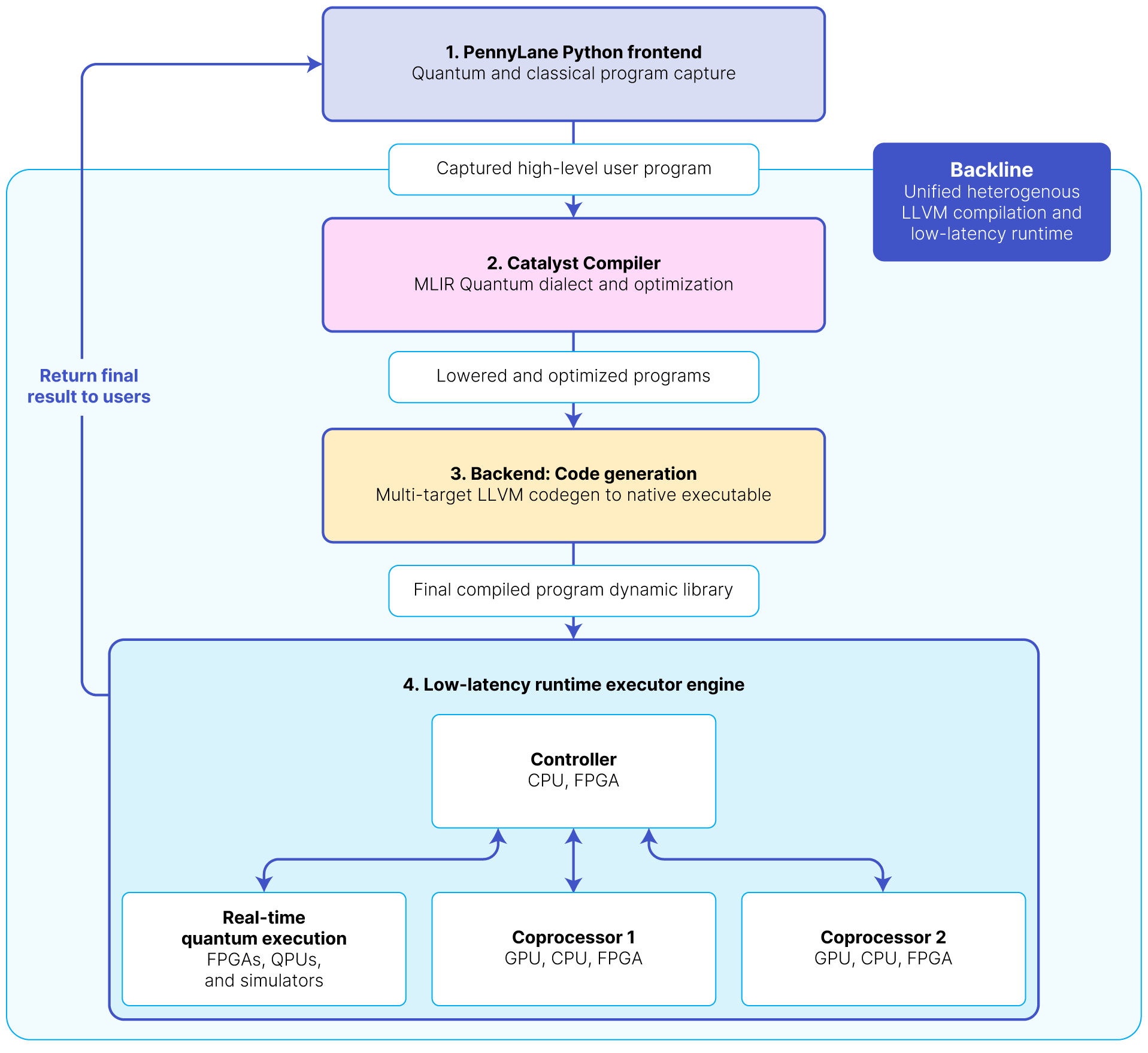
From Python to hardware
- 01
PennyLane (opens in a new tab) Python frontend
Quantum and classical program capture.
- 02
Catalyst (opens in a new tab) compiler
MLIR quantum dialect and optimization.
- 03
Code generation
Multi-target LLVM codegen to a native executable.
- 04
Low-latency runtime
Controller, real-time quantum execution and coprocessors across FPGAs, QPUs, simulators, GPUs and CPUs.
<3 μs
End-to-end latency loop
~1.7 μs
Median round trip time from FPGA to CPU
~3.8 μs
Median round trip time from FPGA to GPU

Quantum computers never run alone. Every useful quantum system depends on classical compute reacting in microseconds, and that is a heterogeneous computing problem AMD is uniquely built to solve.
Scott Tease
Corporate Vice President, HPC and Sovereign AI, AMD
Read more
Go deeper on Backline
- PennyLane blog
There and back again: a 1.74 µs tale with Backline
November 16, 2026
With NVIDIA's Holoscan Sensor Bridge, Backline's FPGA-to-CPU round trip latency falls to 1.74 µs, the lowest published for quantum control over a switched network protocol.
- PennyLane blog
Bring your own decoder: hierarchical QEC decoding with Backline, NVIDIA Ising, and PyMatching
October 13, 2026
Bring your own QEC decoder to Backline: we run NVIDIA's Ising AI pre-decoder on an AMD Instinct GPU with PyMatching for online decoding, all from Python.
- Press release
Xanadu and AMD launch Backline to streamline CPU, GPU, FPGA integration for quantum technology
September 10, 2026
Xanadu and AMD open-source Backline, expanding PennyLane to bridge quantum processors with classical hardware engines.
- AMD blog
Unlocking real-time speed for the quantum ecosystem with PennyLane, Backline, and AMD
September 10, 2026
How to use Backline to deploy PennyLane quantum algorithms across AMD FPGAs, GPUs, and CPUs with near-real-time performance.
- PennyLane demo
How to use PennyLane and Backline for low-latency quantum error correction on GPUs and FPGAs
September 9, 2026
Scale quantum error correction from local CPU prototyping to remote FPGA and GPU execution, with custom Triton kernels, entirely from Python.
- Research paper
Python in the front, party in the Backline: compiling quantum workloads across CPUs, GPUs, and FPGAs
arXiv · September 8, 2026
Backline, a heterogeneous compilation and runtime framework built within PennyLane and Catalyst, demonstrated with microsecond-scale co-processing across CPUs, GPUs, and FPGAs.















Get started
Backline is available today
Install Backline and deploy entirely from Python, from local prototyping with CPUs to low-latency remote execution with FPGAs and GPUs.
FAQ
Frequently asked questions
Backline is an open platform for compilation and low-latency execution, co-designed by Xanadu and AMD. It dynamically connects quantum workloads to the right classical engine, and is available today as an open-source feature suite within PennyLane.
AMD, the AMD Arrow logo, AMD EPYC, AMD Instinct, Threadripper, Versal, ROCm, and combinations thereof are trademarks of Advanced Micro Devices, Inc. Other product names used on this page are for identification purposes only and may be trademarks of their respective owners.