
Aurora
The world's first scalable, networked and modular quantum computer
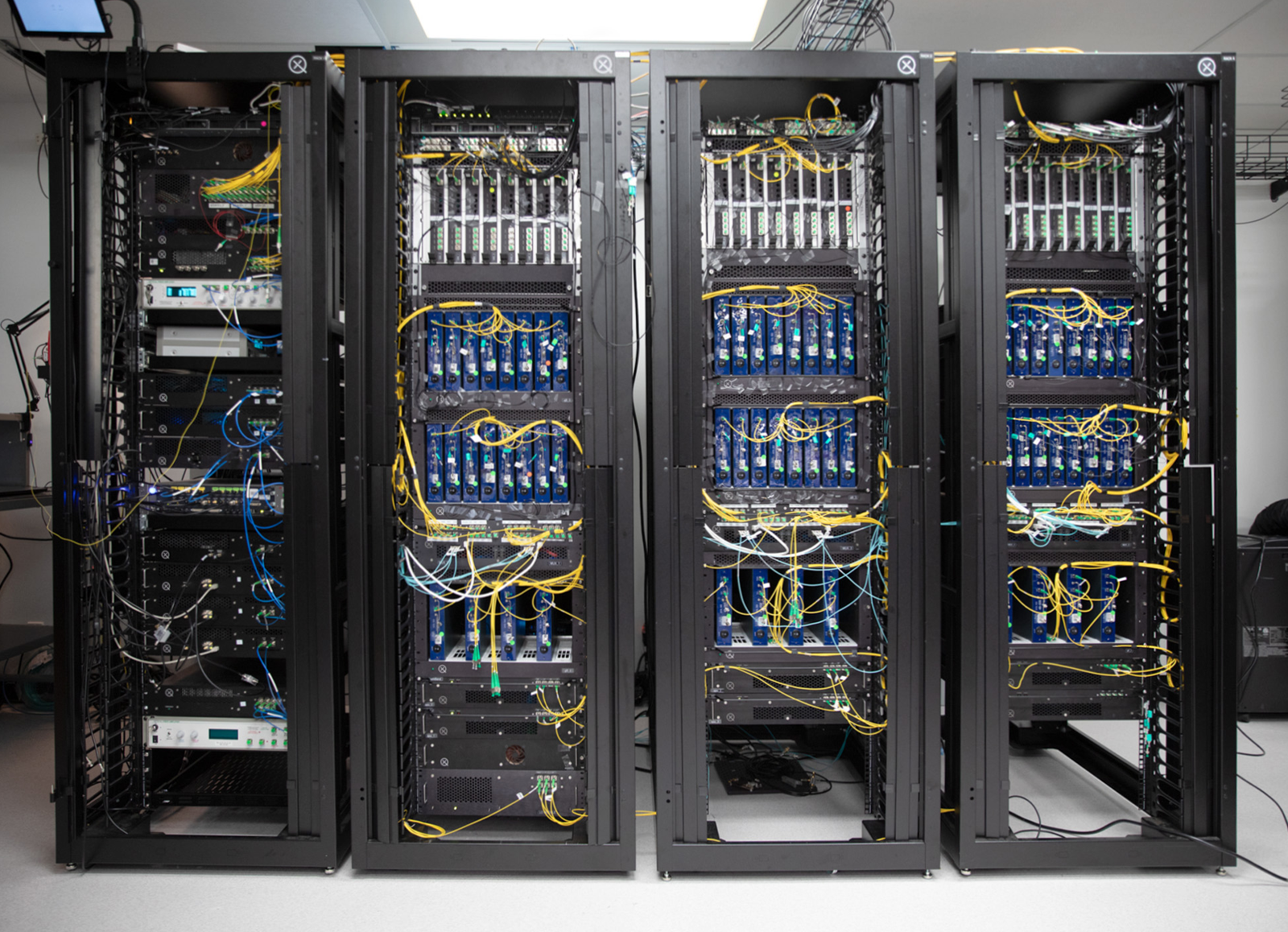
Four modular server racks, photonically interconnected and networked together. 35 photonic chips and 13 km of fiber, all operating at room temperature.
Why it matters
Built to scale to a quantum data center
With this breakthrough, Aurora could in principle be scaled up to thousands of server racks and millions of qubits today, realizing the ultimate goal of a quantum data center.
It is the very first time we—or anyone, for that matter—have combined all the subsystems necessary to implement universal and fault-tolerant quantum computation in a photonic architecture.
12
Qubits
35
Photonic chips
13 km
Of fiber optics
4
Room-temperature server racks
Inside Aurora
A complete prototype of a universal photonic quantum computer


Qubit sources
24 qubit source chips.
Multiplexers
6 multiplexer chips.
QPU
5 quantum processing unit (QPU) chips.
Detection
36 detectors, housed in a cryostat (the only cryogenic component in Aurora).


Scalable, modular, networkable
A truly useful quantum computer will require a very large number of physical qubits, necessitating an approach that includes a clear template for scaling up. Modularity is thus crucial: there must be a straightforward way to distribute the qubits amongst discrete modules that can be mass-manufactured independently. And modularity is useless without the ability to network the modules together. Aurora is a powerful demonstration of all three.
Put to the test
In one trial, we ran the system continuously for two hours and monitored the entanglement present in the cluster state over 86 billion modes—the largest number ever accessed in a context like this. Quantum correlations were also used to verify that the single-clock-cycle decoding functions were working properly.


The two big challenges remaining for the industry are the improved performance of the quantum computer (error correction and fault tolerance) and scalability (networking). Xanadu has now solved scalability. Photonics really is the best and most natural way to both compute and network.
Christian Weedbrook
Founder and CEO, Xanadu
Read more
Go deeper on Aurora
![]() Blog
Lighting up the quantum computing horizon with Aurora
January 22, 2025
A peek inside Xanadu’s latest and greatest photonic quantum computer—Aurora.
 Press release
Xanadu introduces Aurora: world's first scalable, networked and modular quantum computer
January 22, 2025
Xanadu has achieved a world-first in the quantum computing industry by successfully building a universal photonic quantum computer consisting of four modular and independent server racks.
![]() Research paper
Scaling and networking a modular photonic quantum computer
Nature · January 2025
A full description of this system was just published in the peer-reviewed journal Nature.


Contact us
Build what's next with Xanadu
Talk to our team about Xanadu's photonic hardware and our path to fault tolerance.