
Community
2026 Xanadu Summer Residency Retrospective
By Emily Nobes · September 23, 2026


By Emily Nobes
In May 2020, Xanadu welcomed the first iteration of their 16-week summer residency program, which invites select graduate students from around the world to work on real projects with real experts on the team. In May 2026, I stepped into the office as a member of the 6th cohort.
Xanadu's residency program was founded with the intention of building upon the traditional model of industry internships by bringing students in as a defined cohort. Residents go through rigorous application processes that mirror those of full time employees, preparing them to take on independent projects. I learned this while chatting with Nathan Killoran, the Senior Vice President of Fault-Tolerant Quantum Computing Software and a residency supervisor, as we walked to get coffee one day. He told me that the company hoped to overcome the sometimes isolating experience of being an intern by encouraging collaboration and camaraderie from the beginning.
There is no doubt this paid off. On the first day of the residency, several of us arrived at the same time and were able to pick each other out of the morning-arrival crowd. We had the chance to chat online as we all figured out our moves to downtown Toronto in anticipation of this in-person opportunity. The shared look of being lost, though, is what allowed us to connect the dots that morning. It was nice to not have to navigate that alone.
We barely had enough time to introduce ourselves before we were swept through a cascade of onboarding, office tours, desk assignments, and supervisor introductions. This briefly preceded the kickoff to our week-long residency bootcamp, so the pace made sense. We spent the week partaking in an introductory week of structured curriculum to get everyone up to speed on the work they will be doing and seeing over the course of the summer. It was a unique opportunity to learn from and converse with some of the most prominent names in the field of quantum computing. The residency program is about learning as much as it is about working.
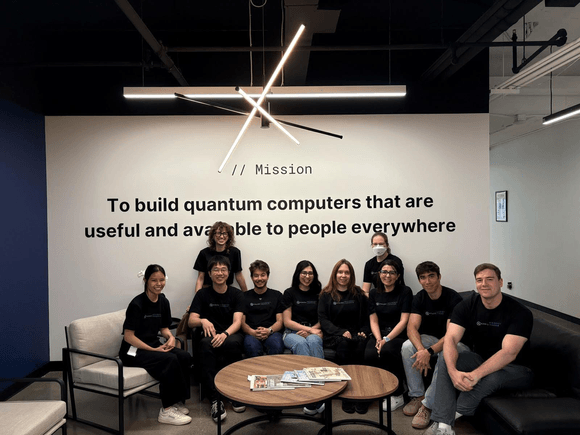
Since that first day, I arrived at the office each morning prepared to push myself and my understanding as far as possible to keep up with the thought leadership and innovation happening at Xanadu. During my residency, I joined the PennyLane content team under the supervision of Josh Izaac to create researcher resources and demonstrations related to some of the biggest algorithms projects at the company. It was exciting to learn about the vibronics simulation algorithm (which has earned Xanadu a finalist spot in the XPRIZE Quantum Applications challenge) and the resonant inelastic X-ray scattering algorithm (RIXS) simulation algorithm in a truly hands-on way.
No matter what time I arrived, fellow resident Kalman Szenes (LinkedIn | Google Scholar) was already at his desk. Kalman's focus was dedicated to his work on the software performance team, which involved optimizing and improving aspects of various performance-critical applications, such as the electronic structure package for vibronic Hamiltonian generation and quantum error correction decoders for GPUs. While the skills he applied were well aligned with his PhD work, he was pleasantly surprised by how much time and effort is dedicated to planning as APIs and software architecture are designed. Experiencing that level of software planning firsthand, he noted, was one of the best parts of the residency.
After getting set up at my desk, the morning would fly by as the office buzzed with a mix of collaboration and concentration. Impromptu idea exchanges at the coffee machine harmonized with hushed project conversations to create an atmosphere of importance. As lunchtime approached, residents who were not heading out for a team lunch or committed to a ping-pong game (more on that later) would meet to share a meal and reflect on the day's work so far.
Isabel Nha Minh Le (LinkedIn), Wendy Billings, and I would often venture to the park near the Xanadu office to get some fresh air as we ate.
Isabel spent the summer working on advancing unitary synthesis, in which unitary matrices are expressed in terms of quantum gates for implementations in quantum circuits. She was able to generalize the method to arbitrary dimensions while conserving parameter optimality, greatly advancing its applicability. It was clear that she loved working in a fast-paced environment with a steep learning curve, and felt great support from the people she worked with here. She also made the most of her time in Toronto in general, and spent many evenings after work and weekends exploring the many summer offerings in the city.
Wendy's summer was defined by a distinct mission: to design a quantum algorithm for modelling Auger decay spectra to be applied to the application of extreme ultraviolet (EUV) photolithography. She took on this project with conviction, and often shared interesting details about her simulations and deliverables. Wendy had the chance to collaborate with individuals across the organization and outside of the organization to push her work forward. This more than paid off, and she was able to see orders of magnitude of improvement in the resource requirements of her focus algorithm.
After lunch, refreshed and refuelled, we would independently dive back into our tasks for the day. The early afternoons were often peppered with 1-on-1 meetings with supervisors and whiteboard sessions at one of the many write-able walls.
Early in the residency, Lukas Brenner (LinkedIn) made a habit of going for a stroll around the office in the middle of the afternoon. Since 3:30 pm is high-time for a coffee break, this quickly evolved into a daily resident gathering. Lukas spent his summer optimizing Gottesman-Kitaev-Preskill (GKP) states for fault-tolerant information processing in photonic architectures. One can imagine how much he learned in the process of this work, but he notes the confirmation that Canadians really do drink milk out of bags as one of his lasting takeaways.
Alexandra Ramôa (LinkedIn | Google Scholar) took coffee time to another level. Between Xanadu's finalist XPRIZE vibronics algorithm and developing an algorithm for Bayesian active learning of dynamic observables, Alex somehow found the time to bake for us. She arrived in Toronto with a suitcase full of cooking supplies, which is especially impressive considering she has spent the last year travelling the world as a visiting researcher and intern. On national intern day, she surprised us with a pistachio cake featuring a customized decal of each resident, which made for great matching desk decor.

In the late afternoon, post-resident coffee time, it was not uncommon to see an uptick in people participating in Xanadu's favourite pastime: ping-pong. The annual ping pong tournament has become synonymous with summer at Xanadu, and many residents could not pass up on the opportunity to take part. Pablo Rodriguez-Grasa (LinkedIn | Google Scholar) was one of the first to register, despite having only briefly picked up a paddle once when he was young. Playing ping pong was a good mental break from his work on exploring what makes quantum models useful for generating data. Pablo and his group discovered the underlying structures of the quantum models they work on are remarkably good at learning from very limited data, allowing them to compress the models down to just 1% of their original size while remaining competitive with classical machine learning methods.
Ping-pong wasn't the only way to take a breather, though. On Friday afternoons, after a long week of challenges and achievements, Xanadu employees gather for Quantum Well Friday, the company's weekly happy hour. I would often find myself chatting with Masato Fukushima (LinkedIn) at these gatherings, who was focused on optimizing the structure of resource states for fault-tolerant logical channels encoded in 3D entangled states that fall under the continuous-variable (CV) noise level. I learned that Masato was surprised at how efficiently the architecture team coordinates to take on and solve challenging, important problems despite its large size. He described this as striking, and thinks it helped make his four months at Xanadu feel productive.
Being in Toronto and a part of the residency team means there is plenty to explore outside work hours as a group. In fact, the Xanadu team organizes several social outings throughout the program. This year, we watched jousting at Medieval times, explored Ripley's aquarium, tried axe throwing, and spent the day at Canada's wonderland as part of these excursions.
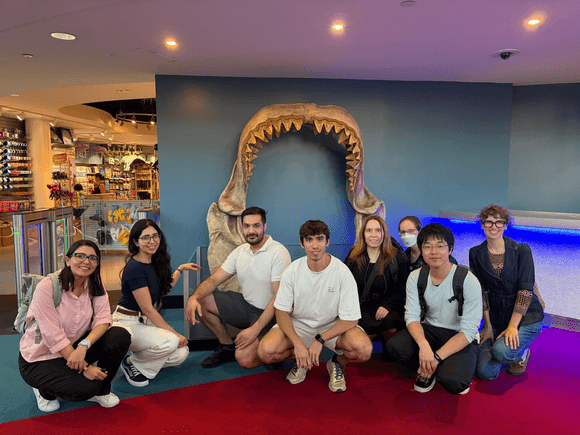
I sat next to Sara Babaee (LinkedIn), a resident on the compilation team, at the first of these events. Focused on implementing phase-folding optimization for both pure quantum circuits and programs with classical control flow for Catalyst, PennyLane's experimental just-in-time (JIT) compilation package. I heard from Sara that she was grateful to have a chance to see the different ways projects are approached in academia and industry, and likens academic research to exploring a massive jungle and running the risk of getting lost on an undefined journey. In industry, though, it feels more like a navigating national park: inviting, goal oriented, and collaborative.
As the summer began to come to a close, we were tasked with preparing final presentations to deliver to the Xanadu team, beyond our supervisors and direct peers. This was our final chance to reflect on what we accomplished as Xanadu residents and slot our contributions into the broader Xanadu ecosystem.
For Mariana Dehghan (LinkedIn), one of the most memorable parts of the experience was getting to know people across the company through conversations that ranged from culture and life to research and new ideas. To her, becoming more comfortable with communicating your ideas and being open to different perspectives is a valuable highlight of gaining work experience in industry. Mariana's work on the compilation team centered around the Virtual Instruction Set Architecture project. She developed optimizations for quantum mapping, routing, and layout restoration while, in tandem, developing a visualization tool to map how qubits move across physical quantum hardware. When I asked her what her favourite part of the residency was, her answer was simple: the people.
Each year, Xanadu opens its doors to contribute to the training and upskilling of the next generation of quantum experts. Having the opportunity to be part of this program is an invaluable experience from start to finish. Having the chance to meet students working on a diverse range of subjects from across the world, spend every day working with and learning from top experts in the field, and contribute in a real way to active, cutting-edge projects is a great way to advance your career and continue your learning.
Applications for the 2027 Xanadu Summer Residency cohort are now open. I speak for myself and all my fellow residents when I say that it is well worth it to take a chance on yourself and apply. Perhaps next year you will find yourself in the lobby of Xanadu headquarters, searching for your fellow residents in the crowd as you stand at the beginning of your shared adventure.
Published on September 23, 2026
Blog
Related articles
![]() Blog
Quantum Week In Toronto: Highlights from IEEE, unitaryCON, IWQC, QRE and Beyond
October 7, 2026
This September, Toronto became the ultimate quantum hub. Learn how Xanadu helped welcome the global quantum community to the city.
![]() Blog
Xanadu and Booz Allen Join Forces to Build a Quantum-Ready Workforce
September 22, 2026
Xanadu and Booz Allen are collaborating to build the next generation quantum-ready workforce. This joint initiative brings together Booz Allen’s…
![]() Blog
Join us at IEEE Quantum Week 2026, IWQC, QRE, and beyond
August 20, 2026
Xanadu is heading to IEEE Quantum Week 2026 in Toronto, and hosting IWQC, QRE, and unitaryCON at Xanadu HQ. Here is where to find our speakers, how…


